
What Is a Trigger Point?
Have you heard of trigger points? While “fascia” — our clinic’s focus — is still not widely known (Ha!), trigger points have gotten more attention through TV and magazines.
Today, let’s start a new mini-series exploring the relationship between trigger points and fascia — with Fascia-chan joining us again!
The “Ahh, Right There!” Spot
You know that feeling when someone presses your shoulder or lower back and you feel a deep, radiating “zing” — and you can’t help but say, “Ahh, right there!”?
That’s a trigger point — a spot where muscles and nerves have become hypersensitive. Interestingly, about 70% of trigger points overlap with traditional acupuncture points (tsubo).
Fascia-chan says: “Hey Ayato-sensei, I’ve been staring at my phone too much and my shoulders are killing me… That ‘zing’ feeling when you press — is that a tsubo?”
It’s a great question. While some call them tsubo, the more precise term is “trigger point.” The “hypersensitivity” means that the body’s sensors (called nociceptors) are in a heightened state of reactivity. When you stimulate these points, the sensation can radiate far from where you’re pressing.
Why “Trigger”?
Fascia-chan says: “Trigger means ‘pulling the trigger,’ right? Why that name?”
Because these points act as the “trigger” that fires off pain and dysfunction. One key characteristic is that they can cause pain to spread to areas far from where you press — this is called referred pain.
Try pressing the outside of your elbow — at a certain point, you’ll feel a deep ache that radiates toward your wrist. That’s referred pain in action!
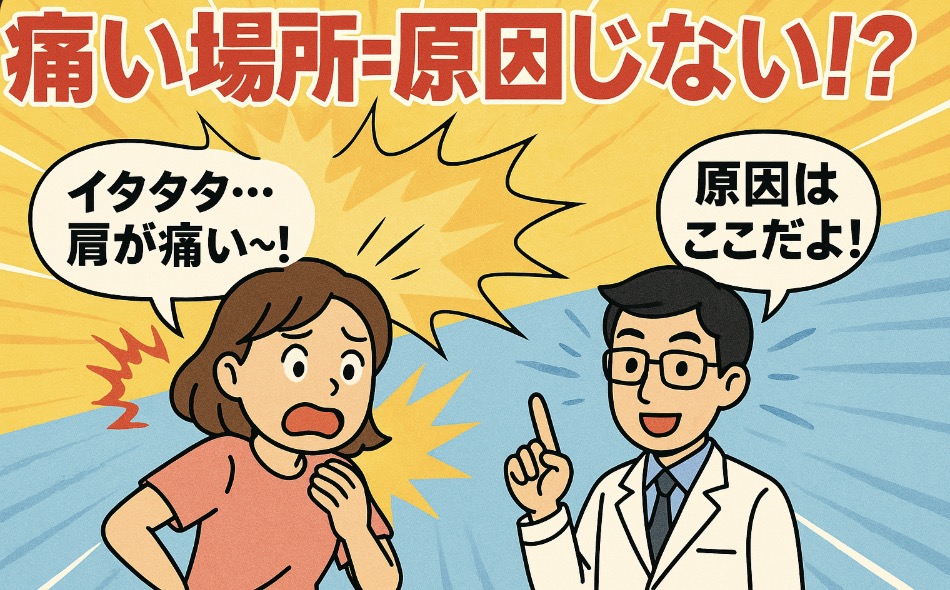
The Pain Isn’t Always Where You Think
Another important feature of trigger points: the source of pain and the location where you feel pain can be completely different.
For example, if a trigger point develops in the shin, the pain might show up not in the shin, but in the knee — a completely different location.
This means that where it hurts ≠ where the cause is. This is a crucial concept in treatment.
Fascia-chan says: “Why do these spots form?”
Overuse, fatigue, and stress cause muscles and nerves to tense up — and the body sends out distress signals. In other words, trigger points are SOS markers from your body.
(Note: Sometimes the painful spot IS the cause — but not always!)
Stay tuned for the next installment, where we’ll dive deeper into the connection between trigger points and fascia!
Before You Visit…
Fair warning: our English is a work in progress! (Ha!)
But thanks to the magic of translation apps, we communicate just fine with patients from around the world.
Your body speaks a universal language — and that’s the one we’re fluent in.