The other day, a patient I hadn’t seen in a while came in for a visit.
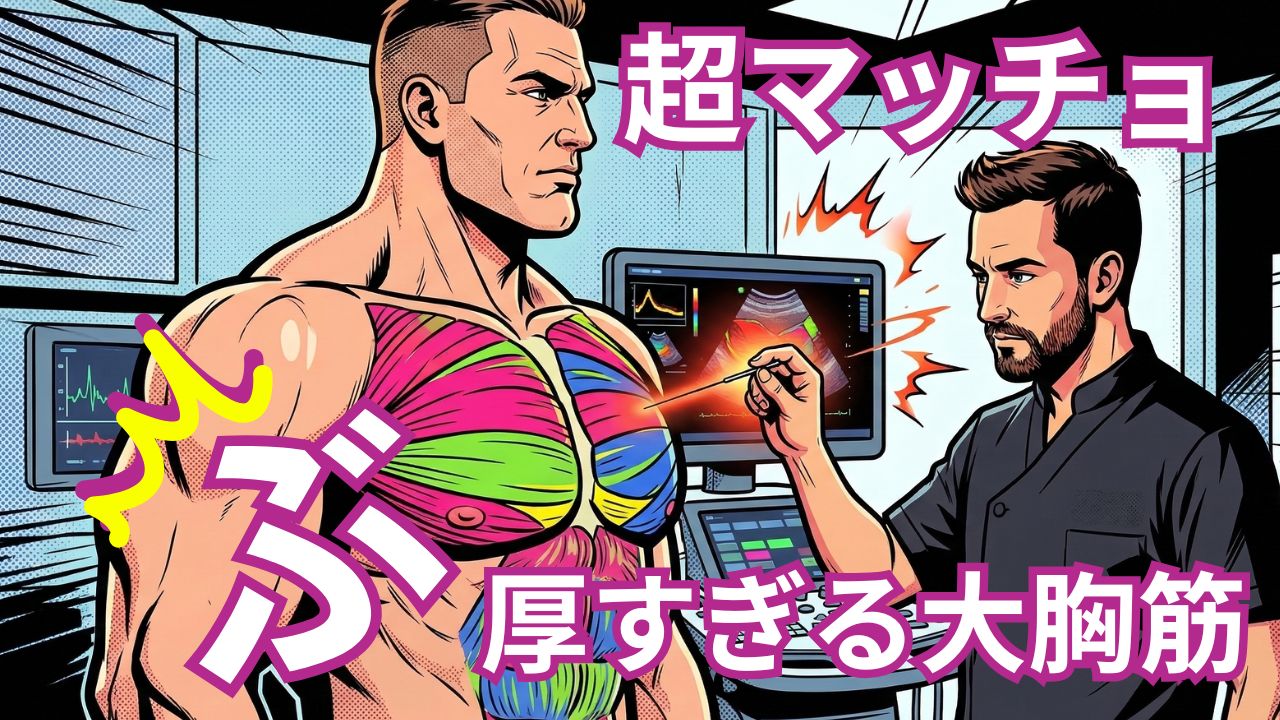
He’s always been into weight training, but when I saw him, I was blown away.
He was noticeably bigger than before — even more built and powerful-looking!
I couldn’t help myself — I just had to use our ultrasound imaging device to get a look at the thickness of his muscles.
The Jaw-Dropping Thickness of His Pecs
When I examined his pectoralis major (chest muscle) with the ultrasound, the sheer thickness was overwhelming.
For a typical person, if you advanced a needle to that depth, you’d be entering dangerous territory — the kind of depth where you risk hitting the lung and causing a pneumothorax (a punctured lung). But with this patient, his muscle was so thick that even at that depth, the needle wouldn’t come anywhere near the lung.
With muscle layers this dense, shallow treatment is no problem at all. The real question is: where exactly is the stubborn, locked-up tissue hiding?
The Source of the Stiffness Lurks Right Next to the Lung
As I used the ultrasound to peer even deeper, sure enough, the areas of stiffness — fascial adhesions and muscular knots — were located in the deepest layers.
Specifically, they were in the fascia along the surface of the ribs, right next to the lung, at the very bottom of the muscular layers.
No matter how thick someone’s muscles are, the spots you really need to reach — the adhesions and the root causes of tension — tend to be found near the bones and the deeper tissues.
Ultrasound: The Key to Safely and Precisely Reaching the Deep Layers
When treating areas this deep — especially near the lungs — this is where ultrasound guidance truly comes into its own.
Relying solely on your hands (palpation) to guide a long needle through thick pectoral muscle toward the lung region is inherently risky, no matter how experienced you are. And hitting the exact fascial layer you’re targeting? That’s an incredibly difficult feat.
But with ultrasound providing a real-time view inside the body, I can see exactly where the tip of the needle is at every moment, how many millimeters remain before it reaches the target fascia, and whether a safe distance from the lung is being maintained.
This means that even when a knot is buried deep beneath thick layers of muscle, I can deliver the needle to the precise spot — down to the millimeter — safely and accurately.
In this particular session, I was able to lock onto that deep fascial stiffness and release it effectively.
It was a powerful reminder of just how important safe, evidence-based acupuncture with ultrasound guidance is — as opposed to guesswork.
On a personal note… after admiring his impressive pecs, I decided to take an ultrasound look at my own sadly modest chest for comparison. The difference was, well, painfully obvious. (Ha!)
I think it might be time for me to hit the weights a little harder!
Before You Visit…
Fair warning: our English is a work in progress! (Ha!)
But thanks to the magic of translation apps, we communicate just fine with patients from around the world.
Your body speaks a universal language — and that’s the one we’re fluent in.
At Kokokara Acupuncture Clinic in Honjo, we provide safe and precise acupuncture treatment using ultrasound imaging.
Whether you’re dealing with an injury from weight training or sports, or struggling with lingering chronic pain, don’t give up — come talk to us.